1977
A scaling method for priorities in hierarchical structures
Saaty, T.L. · Journal of Mathematical Psychology 15(3)
The founding paper: the eigenvector method, the 1–9 scale, and consistency measurement all appear here first.
Notable papers, books and videos related to the Analytic Hierarchy Process
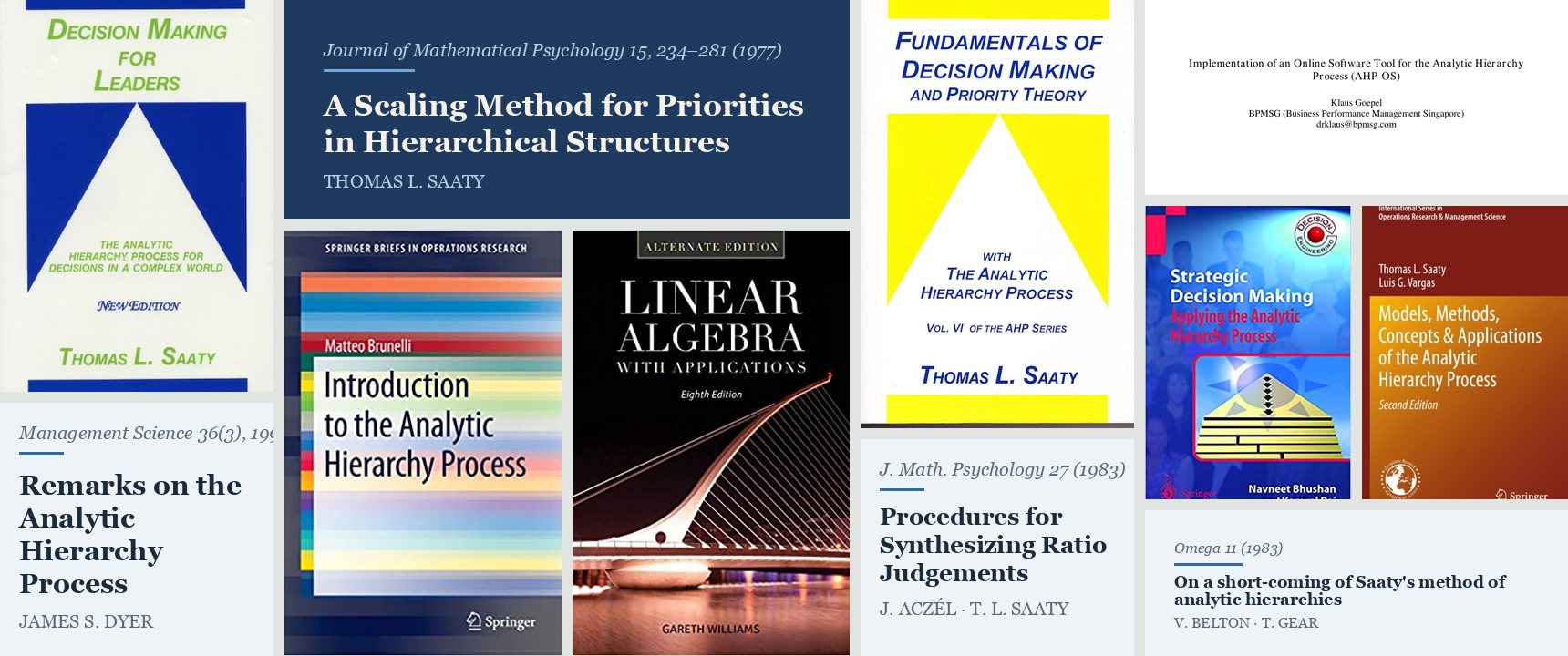
We gather together a collection of influential papers, books and videos related to the Analytic Hierarchy Process. These capture the foundation of the method, and how it was refined and extended over time. The best “how to” content is also included, along with background reading on related topics such as linear algebra.
Grouped by the major developments in each era: foundations, critiques and refinements, group aggregation, and modern surveys.
Saaty, T.L. · Journal of Mathematical Psychology 15(3)
The founding paper: the eigenvector method, the 1–9 scale, and consistency measurement all appear here first.
Saaty, T.L. · Management Science 32(7)
The formal footing: the axioms under which the AHP's ratio-scale priorities are justified.
Saaty, T.L. · Mathematical Modelling 9(3–5)
The accessible overview in Saaty's own words, and still an excellent introduction for novices.
Belton, V. & Gear, T. · Omega 11(3)
The original rank-reversal critique: adding a copy of an alternative can change the ranking of the others. It started the longest-running argument in the field.
Dyer, J.S. · Management Science 36(3) · with Saaty's response in the same issue
The sharpest critique exchange in the literature: Dyer argues the method's rankings are arbitrary without utility-theoretic footing; Saaty answers in the same issue. Read both sides together.
DOIINFORMSGoogle ScholarResearchGate
Aczél, J. & Saaty, T.L. · Journal of Mathematical Psychology 27(1)
The proof that the geometric mean is the only aggregation of group judgments consistent with unanimity and reciprocity. This explains why AIJ is the most common method for combining judgments.
Saaty, T.L. · European Journal of Operational Research 48(1)
The most-cited tutorial introduction, with the worked examples most courses still teach from. The practical companion to the 1987 overview.
Forman, E. & Peniwati, K. · European Journal of Operational Research 108(1)
Settles when a group should aggregate judgments (acting as one decision maker) versus priorities (acting as separate individuals).
Harker, P.T. · Mathematical Modelling 9(11)
How to derive priorities when not every pair has been compared, cutting respondent burden without abandoning the eigenvector method. The standard reference for incomplete matrices, and the method behind how missing comparisons are handled on our mathematics page.
Triantaphyllou, E. & Sánchez, A. · Decision Sciences 28(1)
The systematic treatment of what “sensitive” should mean in a weighted decision: whether to count any rank swap or only a change at the top, and whether to measure weight changes in absolute points or relative to the weight itself. Their Percent-Top measure is the stability rating decisionpoint.io's Sensitivity page uses.
Alonso, J.A. & Lamata, M.T. · International Journal of Uncertainty, Fuzziness and Knowledge-Based Systems 14(4)
Re-estimates the random index from large-scale simulation and fits a simple closed-form rule to it, giving consistency thresholds that work at any matrix size. Their estimates appear in the consistency discussion on our mathematics page.
Chen, H. & Kocaoglu, D.F. · European Journal of Operational Research 185(1)
Extends sensitivity analysis from a single level to the whole hierarchy at once, including simultaneous changes to several weights.
Ishizaka, A. & Labib, A. · Expert Systems with Applications 38(11)
The standard methodological survey: judgment scales, priority-derivation methods, consistency indices and group aggregation, compared side by side.
Emrouznejad, A. & Marra, M. · International Journal of Production Research 55(22)
A citation-network history of four decades of AHP research, identifying the seminal papers and how the field's themes evolved. The bibliometric companion to the methodological surveys.
Ho, W. & Ma, X. · European Journal of Operational Research 267(2) · Invited Review
The standard post-2011 general review, covering how the AHP is combined with other methods and where it is applied. Start here for the current state of the field.
Goepel, K.D. · International Journal of the Analytic Hierarchy Process 10(3)
The reference description of AHP-OS, a free online AHP tool widely used in academic studies. Useful both as documentation and as a record of the design choices a web implementation must make.
From the non-technical introduction to the mathematics behind the method.
An introductory text for the mathematics behind the AHP: vectors, matrices, eigenvalues and eigenvectors. Needed for studying AHP theory, not for applying the method. The alternate edition covers the AHP-relevant material earlier.
Thomas L. Saaty explaining his own method in official Creative Decisions Foundation uploads, plus one applied walk-through by the author of AHP-OS.
Why Saaty developed the method after his State Department work: “we needed a new way to measure things.”
The origin and rationale of the fundamental scale.
The 1970s hierarchy Saaty and his son used to pick a high school — one of the first AHP applications.
A validation exercise: size ratios of apples in a pairwise comparison matrix.
The classic validation example: relative US beverage consumption from pairwise judgments alone.
Absolute measurement: rating employees one at a time against standards instead of each other.
AHP used to predict elections, economic turnarounds and sports outcomes.