Selecting a Warship for the Brazilian Navy
The Analytic Hierarchy Process to choose between three candidate corvette classes for the Brazilian Navy
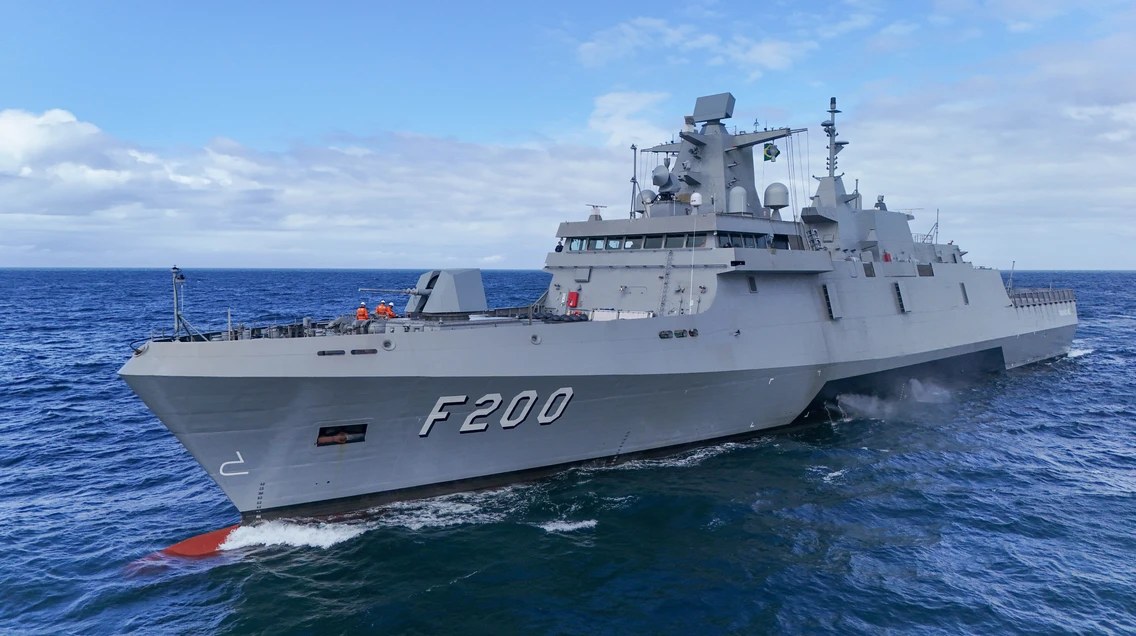
Choosing a family car is one thing. Choosing a warship is another. Yet at its heart the problem is the same: you have a handful of candidates, you care about a long list of attributes, and you need a defensible way to weigh them up.
The Brazilian Navy is required to maintain a fleet of 18 escort ships, comprising frigates, corvettes and destroyers, but its older vessels are nearing the end of their useful lives and the budget for replacements has been tight for years. The Navy's most recent corvette, the Barroso, took 14 years to build (1994 to 2008), making it "a new ship, but not a modern one". Its design is an improved version of the Inhaúma class, itself an early 1980s platform. The strategic question was whether to keep building the Barroso class for the next round of fleet renewal, or to move to a larger and more capable design.
In 2021 a team of academic and military researchers published a peer-reviewed study[1] applying the Analytic Hierarchy Process to exactly that question. The three candidates were the Barroso (replicating the existing 2,500-ton corvette), the CV-2600 (a slightly modernised 2,600-ton design), and the CV-3000 (a more substantial 3,000-ton design with significant modernisations). The "CV" prefix denotes Combat Vessel; the number indicates intended displacement in tons. The candidates were assessed against nine criteria spanning combat capability, operational endurance and cost. The criteria weights came from interviews with ten Brazilian Navy officers, while the alternative comparisons came from ratios of measured attribute data such as gun calibres and ranges in nautical miles.
Why We Chose This as a Case Study
The Santos study is an appealing example of the AHP for several reasons.
It is a real-world application, drawn from the Brazilian Navy's fleet renewal program rather than a teaching example. The criteria, the candidate classes and the trade-offs all come from the procurement domain, not a textbook.
It is published in the field's premier journal. The International Journal of the Analytic Hierarchy Process is the dedicated peer-reviewed outlet for AHP research, which gives us a rigorous reference implementation to compare against.
It exercises fractional judgment values heavily. The paper derives its comparison values by column-normalising raw attribute data, which produces lots of non-integer ratios. decisionpoint.io supports fractional values natively, and seeing them stretched across a nine-criteria military model is a good stress test.
Finally, the decision is decisive. The winner pulls clear of the field, and the sensitivity analysis confirms the result is robust to changes in the criteria weights. It is a worked example of what a well-supported AHP decision looks like.
The Decision Model
The Goal
The Brazilian Navy must decide whether to continue building the Barroso class, or commit to a larger and more capable replacement.
The Hierarchy
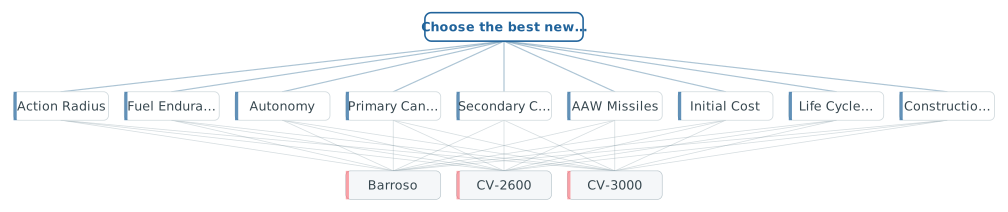
The decision uses a flat two-level hierarchy: the goal at the top, nine criteria directly underneath, and three alternatives at the bottom. There are no subcriteria; every criterion is compared directly against the alternatives.
The Nine Criteria
The criteria fall into three natural groups.
Operational range and endurance:
- Action Radius: the maximum distance the ship can travel from base and return without refuelling.
- Fuel Endurance: how far the ship can travel on a full load of fuel.
- Autonomy: how long the ship can stay at sea before resupply, governed by stores rather than fuel.
Combat capability:
- Primary Cannon: the main naval gun, a measure of surface and shore bombardment capability.
- Secondary Cannon: smaller-calibre guns for close defence and anti-surface engagement.
- AAW Missiles: anti-air warfare missile capacity, the ship's ability to defend itself and others against air attack.
Cost and schedule:
- Initial Cost: the up-front procurement price.
- Life Cycle Cost: the total cost of ownership over the ship's service life, including operations, maintenance and crew.
- Construction Time: how long it takes to deliver the ship from contract signing.
The Three Alternatives
| Alternative | Description |
|---|---|
| Barroso | The Brazilian Navy's existing corvette class, used as a baseline incumbent. |
| CV-2600 | A 2,600-ton candidate design, slightly larger and modestly modernised. |
| CV-3000 | A 3,000-ton candidate design, larger and more capable. |
The CV-2600 and CV-3000 labels represent design concepts at different displacement classes rather than specific named ships. Comparing them against the existing Barroso class gives a baseline for what an upgrade actually buys.
The Pairwise Comparisons
How the Comparisons Were Derived
The Santos paper uses two different methods, one for each level of the hierarchy.
Criteria comparisons were derived from expert judgment. The authors interviewed ten Brazilian Navy officers with more than twenty years of experience, who supplied pairwise assessments on Saaty's standard 1-9 scale (e.g. "cost matters much more than capability"). This is the classic AHP approach for subjective importance weighting.
Alternative comparisons were derived from measured data. Each criterion has a quantifiable underlying value (nautical miles for Action Radius, calibre for Primary Cannon, displacement-derived dollars for the cost criteria, months for Construction Time, and so on). The authors take these raw attribute values from naval engineering specifications, normalise them by column sum, and convert the normalised values into pairwise ratios — producing precise but typically non-integer comparison values for each alternative on each criterion.
Both methods land on the same mathematical object, a reciprocal pairwise comparison matrix, and the AHP processes them identically. The fractional approach simply lets the data drive the alternative comparisons directly when measured attribute values are available.
There are 63 pairwise comparisons across 10 scorecards in this decision: one for the criteria themselves and one for each of the nine criteria against the three alternatives.
Criteria Comparisons: What Matters Most?
The first scorecard sets the relative weights of the nine criteria. The paper's normalisation produces the following criteria weights, which decisionpoint.io reproduces within a thousandth on every value:
| Criterion | Weight |
|---|---|
| Construction Time | 0.220 |
| Initial Cost | 0.190 |
| Life Cycle Cost | 0.190 |
| Primary Cannon | 0.110 |
| AAW Missiles | 0.070 |
| Action Radius | 0.060 |
| Fuel Endurance | 0.060 |
| Autonomy | 0.060 |
| Secondary Cannon | 0.020 |
Three things stand out.
Cost and schedule dominate. Construction Time, Initial Cost and Life Cycle Cost together account for 60% of the decision weight. The Brazilian Navy is buying capability under tight fiscal constraints, and the criteria weights reflect that.
Combat capability is split into uneven pieces. The Primary Cannon carries weight (11%), AAW Missiles a moderate amount (7%), and the Secondary Cannon almost nothing (2%). Within combat capability, the largest gun matters most.
Range, endurance and autonomy are equal. Each is rated at 6%, totalling 18% for the operational range cluster. Substantial in aggregate, but no single endurance criterion dominates.
Alternative Comparisons
With the criteria weighted, the three vessels are compared on each criterion in turn. The paper supplies attribute values from naval engineering specifications (ranges in nautical miles, gun calibres, missile counts, displacement-derived costs, construction schedules), which are normalised and converted to pairwise ratios.
A handful of comparisons illustrate the approach.
Action Radius (6% weight). The CV-3000 has the longest range, the CV-2600 sits in the middle, and the Barroso the shortest. The pairwise ratios are derived directly from the published nautical-mile figures.
Primary Cannon (11% weight). The CV-3000 carries the largest main gun, with the other two trailing. Calibre maps cleanly to a numeric ratio, so this scorecard is one of the more straightforward.
AAW Missiles (7% weight). The Barroso class as represented in the paper carries no AAW missile capability at all, while both CV designs are missile-equipped. A literal zero cannot be represented in the AHP because the method works in ratios; we mapped the gap to Saaty's "extreme" intensity (9), which gives Barroso a small but non-zero priority on this criterion. Despite this concession, the final ranking matches the paper exactly. See the methodology note at the end for details.
Initial Cost and Life Cycle Cost (19% weight each). Costs scale with displacement, so the Barroso is cheapest and the CV-3000 most expensive. These two criteria pull in the opposite direction to capability, which is the central trade-off in the model.
Construction Time (22% weight). The largest criterion. Smaller ships are quicker to build, so the Barroso wins here, the CV-2600 is in the middle, and the CV-3000 takes the longest. Combined with the cost criteria, this gives the smaller designs a substantial head start on 60% of the decision weight.
Consistency
At first glance, the decision appears to have perfect consistency: the average consistency ratio reported at the top of the results page is 0.00. The reality has a little more texture. That displayed figure rounds an underlying mean of 0.004, made up of nine alternative scorecards at exactly 0.00 and one criteria scorecard at 0.04. The zeroes on the alternative scorecards are a built-in consequence of their derivation from normalised attribute values, which produces ratios that are transitive by construction. The 0.04 on the criteria scorecard reflects the small inconsistencies that are normal in human pairwise judgments, well inside the conventional 0.10 "consistent" threshold but not zero.
Results

Overall Ranking
| Rank | Alternative | decisionpoint.io Score | Paper Score | Difference |
|---|---|---|---|---|
| 1st | CV-3000 | 0.393 | 0.393 | 0.000 |
| 2nd | CV-2600 | 0.318 | 0.318 | 0.000 |
| 3rd | Barroso | 0.289 | 0.289 | 0.000 |
The ranking matches the paper exactly, to three decimal places. The CV-3000 is the recommended vessel, comfortably ahead of the CV-2600, with the existing Barroso class a clear third.
The 0.075 gap between first and second place is large in AHP terms. The model speaks with a confident voice.
What Drove the Result?
The CV-3000 wins despite being the most expensive option and the slowest to build. To beat the cost-and-schedule criteria, which together account for 60% of the weight, it has to win convincingly on the criteria that remain.
It does. The CV-3000 leads on:
- Action Radius, Fuel Endurance, Autonomy. A larger hull carries more fuel and stores. Across the three endurance criteria (18% weight combined), the CV-3000 takes the top spot on all three.
- Primary Cannon. The biggest ship carries the biggest gun, so the CV-3000 takes 11% of the weight here too.
- AAW Missiles. With the Barroso class effectively absent from this criterion (no AAW capability) and the CV-3000 carrying the largest missile loadout of the three candidates, the CV-3000 picks up another 7%.
That is roughly 36% of the decision weight on which the CV-3000 is the strongest performer.
The Barroso's cheapness and quick construction are not enough to overcome its operational shortcomings. It cannot project force as far, cannot stay on station as long, has the smallest main gun, and lacks AAW missiles entirely. The cost criteria reward it, but the capability criteria penalise it more heavily.
The CV-2600 is the middle option in almost every dimension, and that is reflected in its middle rank.
Sensitivity Analysis
The sensitivity analysis tells us how robust the ranking is to changes in the criteria weights. The result here is unusually stable.
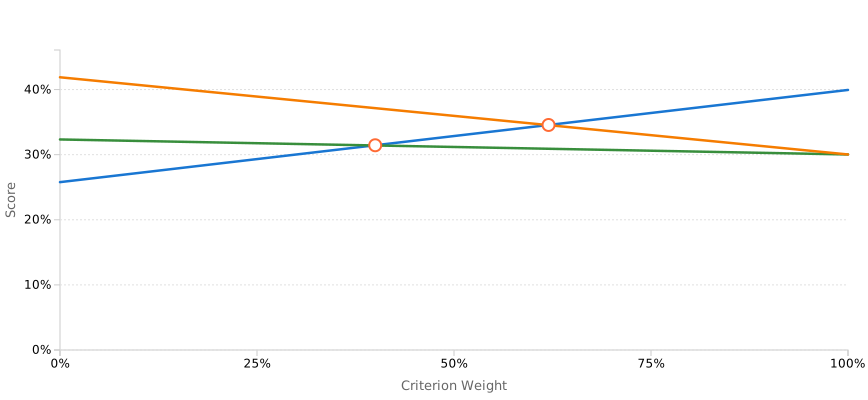
The chart above tracks the criterion that does the most work to push back against the result: Construction Time, the largest criterion in the model at 22%. The Barroso (cheapest and quickest to build) is best on this criterion, the CV-3000 worst. As the weight on Construction Time increases, the Barroso line climbs and the CV-3000 line falls. The first crossover, where Barroso passes the CV-2600, occurs at about 40% weight, which lines up with the published Critical Δ of ±18 percentage points. The full reversal, where the Barroso overtakes the CV-3000 to win outright, does not happen until around 62%.
Stability Overview
| Rating | Count |
|---|---|
| Stable | 7 |
| Moderate | 1 |
| Sensitive | 1 |
Seven of the nine criteria are Stable. The ranking is robust against substantial reweighting of most criteria. Only two — Construction Time and AAW Missiles — can shift the outcome, and even those require significant movement.
Stability by Criterion
| Criterion | Weight | Critical Δ | Stability |
|---|---|---|---|
| Construction Time | 22% | ±18% | Moderate |
| Initial Cost | 19% | ±46% | Stable |
| Life Cycle Cost | 19% | ±46% | Stable |
| Primary Cannon | 11% | — | Stable |
| AAW Missiles | 7% | ±6% | Sensitive |
| Action Radius | 6% | — | Stable |
| Fuel Endurance | 6% | — | Stable |
| Autonomy | 6% | ±33% | Stable |
| Secondary Cannon | 2% | — | Stable |
A dash in the Critical Δ column means there is no weight at which the ranking changes; the criterion is so aligned with the overall result that no realistic shift would alter the order.
What This Tells Us
Construction Time is the most weight-sensitive criterion that actually pushes back against the result. It is the largest single criterion (22% weight) and the only major one on which the CV-3000 is the worst performer. A shift of ±18 percentage points in its weight would be needed to overturn the ranking, which is a moderate but not trivial buffer.
The cost criteria are remarkably resilient. Initial Cost and Life Cycle Cost each carry 19% weight, and the ranking holds across an enormous ±46% range on either. That is because cost is already tipping in favour of the smaller ships; reweighting it harder simply tells you the same story.
AAW Missiles is the only Sensitive criterion, but it does not matter much in practice. Critical Δ is ±6 percentage points, but the criterion is only weighted at 7% to begin with, so the absolute change in its contribution is small. It does not unseat the CV-3000.
The capability criteria the CV-3000 wins on are flat-line stable. Action Radius, Fuel Endurance, Primary Cannon and Secondary Cannon all show no critical threshold at all. You could push their weights to extremes and the CV-3000 would still come out on top.
The Practical Implication
For the Brazilian Navy, the recommendation from the paper is not "CV-3000, by a hair." It is "CV-3000, comfortably." The sensitivity analysis backs that up: the only realistic way to overturn the ranking is to put substantially more weight on Construction Time than the model already does, and even then the threshold is large enough to require a deliberate policy choice rather than a marginal judgment shift.
That is what a well-supported AHP decision looks like. The result holds up under stress.
What Happened Next
The paper analyses three notional design classes. The Brazilian Navy's actual fleet renewal program ran in parallel: the Tamandaré-class procurement, launched in 2017, ran an open international competition between four shipbuilder consortia.
In March 2019 the Navy selected the Águas Azuis consortium, led by ThyssenKrupp Marine Systems, with a design based on the MEKO A-100 platform[2]. The MEKO A-100 is a modern modular frigate design with stealth features: reduced radar cross-section, screened superstructure, and angled upperworks to lower detectability. The contract was signed in March 2020. At roughly 3,500 tons displacement, the resulting Tamandaré-class is larger again than the CV-3000 modelled in the paper — large enough to change classification. The program had been launched in 2017 as the Tamandaré Class Corvettes (the CCT designation it still carries internally), but the winning 3,500-ton MEKO A-100 design crossed the threshold from corvette into frigate territory, and the Brazilian Navy reclassified the ships accordingly.
The first ship of the class, the Tamandaré, was christened in December 2024 and entered service in 2026.
The candidates Santos modelled (Barroso, CV-2600, CV-3000) are abstract displacement-class concepts rather than the specific designs offered by the bidders. How much the AHP analysis fed into the actual procurement is unclear. What is clear is the directional finding: a larger, more capable hull beats a smaller, cheaper one once operational range and combat capability are properly weighted. The Brazilian Navy reached the same conclusion in the real procurement: the winning design was 3,500 tons, the largest of the four bids, and big enough that the program eventually retitled its ships from corvettes to frigates.
Try It Yourself
This decision is published as a public, interactive model on decisionpoint.io. You can:
- Explore the full decision: view the hierarchy, all 63 comparisons, and the detailed results.
- Run your own sensitivity analysis: adjust the criterion weights and see how the ranking responds.
- Create your own AHP decision: use the same tool to make your own multi-criteria decisions.
Methodology Notes
Column Normalisation Versus Saaty Intensities
The Santos paper derives the alternative comparisons by column-normalising measured attribute data and computing the resulting ratios; the criteria comparisons use Saaty's standard 1-9 scale instead, derived from the officer interviews. The column-normalisation route is mathematically equivalent to populating a Saaty pairwise matrix with non-integer entries: both produce a reciprocal matrix, and both feed into the same eigenvector calculation. decisionpoint.io accepts fractional judgment values directly, so no translation step is needed for the alternative scorecards.
Handling a Zero Value on AAW Missiles
The AHP works in pairwise ratios on Saaty's 1-9 scale, where 1 means "equally important" and 9 means "extremely more important." The lower bound of 1 isn't arbitrary: there is no concept of "less than equally important." If B is more important than A, the comparison flips direction and the matrix records the reciprocal of a value greater than 1. So the scale never reaches zero, and a literal zero in source data would imply an infinite ratio that the bounded scale cannot accommodate.
The paper records zero AAW missile capacity for the Barroso class. We resolved this by mapping the Barroso vs CV-2600 and Barroso vs CV-3000 comparisons on this criterion to Saaty's "extreme" intensity (9), the largest value the scale allows. The result is that Barroso receives a small but non-zero priority on AAW Missiles (around 0.05), rather than the paper's exact zero. This is a standard practical adjustment when reproducing AHP studies that contain a true zero. Because AAW Missiles carries only 7% of the overall weight and Barroso was already heading for third place, the adjustment does not change the final ranking, which matches the paper to three decimal places.
How decisionpoint.io Calculates AHP Priorities
decisionpoint.io uses the eigenvector method to derive priorities from pairwise comparison matrices, in line with Saaty's original AHP methodology[3]. The Santos paper does not name the AHP software used to compute its priorities; its column-normalisation method is the closed-form arithmetic alternative to the eigenvector method. Both approaches converge on the same priorities for consistent matrices and produce values within thousandths of each other for matrices with mild inconsistency. For this study every reproduced score matches the published value exactly to three decimal places, which is a useful sanity check on both implementations.
References
-
Santos, M., Costa, I.P.A., & Gomes, C.F.S. (2021). "Multicriteria Decision-Making in the Selection of Warships: A New Approach." International Journal of the Analytic Hierarchy Process, 13(1). https://www.ijahp.org/index.php/IJAHP/article/view/833
-
Wikipedia contributors. "Tamandaré-class frigate." Wikipedia, The Free Encyclopedia. https://en.wikipedia.org/wiki/Tamandar%C3%A9-class_frigate
-
Saaty, T.L. (1990). "How to make a decision: The Analytic Hierarchy Process." European Journal of Operational Research, 48(1), 9-26.