Wikipedia Example: Buying a Car
A family uses the Analytic Hierarchy Process to choose between six Honda models, balancing cost, safety, style, and capacity.
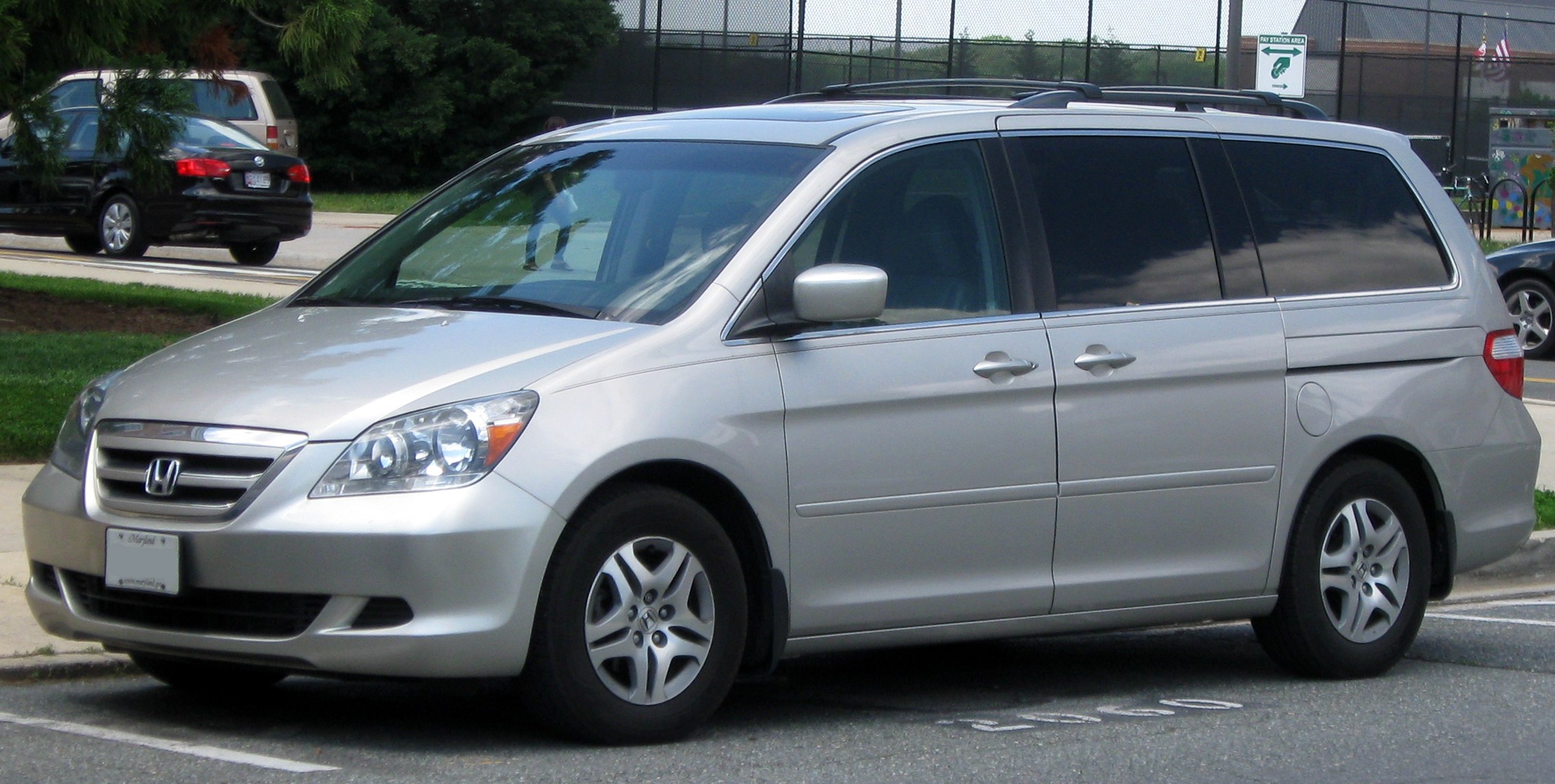
If you've ever searched online for an AHP example, there's a good chance this is the one you found. The Wikipedia car buying article[1] is the most widely-read introduction to the Analytic Hierarchy Process on the web, and it has probably introduced more people to the AHP than any textbook.
The example follows the Jones family as they choose a new car. They're a Honda-only family (which conveniently narrows the alternatives to a manageable set), and they care about four things: how much the car costs, how safe it is, how it looks, and how much it can carry. Straightforward on the surface, but complex enough that it would be difficult to make a balanced decision using intuition alone.
The example covers an instructive range of criteria. Some are precisely measurable: purchase price can be pinned down to the penny. Others require estimation, like resale value four years from now. And at least one, style, is entirely subjective. The AHP accommodates all three types in one framework.
Wikipedia contributors put the example together based on Thomas Saaty's foundational AHP texts, particularly Decision Making for Leaders (2008)[2]. It has since been reimplemented in various AHP tools and libraries, including R's ahp package[4] and Python's AHPy[5]. We've recreated it in decisionpoint.io as a fully interactive public decision, with sensitivity analysis included.
Why We Chose This as Our First Case Study
It's a good first case study because it's complex enough to be realistic (10 criteria across three hierarchy levels, six alternatives, 133 comparisons in total) but familiar enough that anyone can follow the reasoning. You don't need to know operations research to have a view on whether safety matters more than style when choosing a family car.
It also touches most of what decisionpoint.io does: hierarchical criteria with subcriteria, objective and subjective comparisons, consistency checking, results synthesis, and sensitivity analysis.
The Decision Model
The Goal
The Joneses need a new car. They've decided to stick with Honda, and have narrowed their options to six current models. Now they need a structured way to weigh up the trade-offs between them.
The Hierarchy
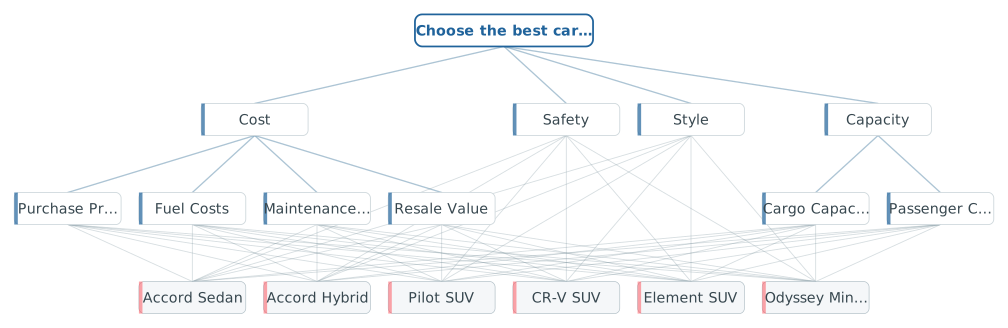
The decision breaks down into a three-level hierarchy.
Level 1: Four main criteria
- Cost: how much will this car cost to buy and own? Note that this isn't just the purchase price, it covers additional factors such as fuel costs and resale value.
- Safety: how well will this car protect the family in an accident? Hondas are generally safe, but there are significant differences between models in terms of safety features.
- Style: how does the car look? This one is entirely subjective, and the AHP gives it equal standing alongside the objective criteria.
- Capacity: how much can the car carry? This covers both people and cargo.
Level 2: Six subcriteria (under Cost and Capacity)
Cost splits into four subcriteria, because "cost" is too broad to compare directly against the alternatives:
- Purchase Price: the sticker price. The family has a $25,000 budget but is open to cars that go over.
- Fuel Costs: based on government MPG ratings, assuming every car is driven the same annual mileage.
- Maintenance Costs: estimated from Consumer Reports ratings, tyre costs, and a mechanic's input.
- Resale Value: four-year residual value percentages from the family's bank.
Capacity splits into two:
- Cargo Capacity: measured in cubic feet, from manufacturer specs.
- Passenger Capacity: number of passengers, ranging from 4 to 8 across the six models.
Safety and Style have no subcriteria. They are compared directly.
Level 3: Six alternatives (Honda models)
| Model | Type | Purchase Price | MPG | Passengers | Cargo (cu ft) |
|---|---|---|---|---|---|
| Accord Sedan | Sedan | $20,360 | 27 | 5 | 14 |
| Accord Hybrid | Sedan | $31,090 | 33 | 5 | 14 |
| Pilot SUV | SUV | $33,150 | 20 | 8 | 87 |
| CR-V SUV | SUV | $20,700 | 25 | 5 | 72 |
| Element SUV | SUV | $18,390 | 23 | 4 | 74 |
| Odyssey Minivan | Minivan | $25,670 | 22 | 8 | 148 |
These cars aren't close substitutes; Sedans, SUVs and a minivan are all considered. Purchase prices range from $18,390 to $33,150. Passenger counts go from 4 to 8. Cargo space ranges from 14 cubic feet to 148. What the AHP does is weigh those differences against the family's own priorities.
The Pairwise Comparisons
How Pairwise Comparison Works
Ranking all six cars at once is cognitively overwhelming, so the AHP breaks the evaluation into pair-by-pair comparisons instead. "Is cost more important than safety? If so, how much more?" Each comparison uses Saaty's 1-9 scale, where 1 means equal importance and 9 means one factor is extremely more important than the other.
There are 133 pairwise comparisons across 11 scorecards in this decision. That sounds like a lot, but each individual comparison is a simple, answerable question.
Criteria Comparisons: What Matters Most to the Joneses?
The family's first task is to decide the relative importance of their four main criteria. That means six pairwise comparisons.
Cost vs Safety (Cost preferred, intensity 3, moderate). This was the comparison the family argued about most. On one hand, "you can't put a price on safety." On the other, the family has a limited budget, nobody has ever had a major accident, and Hondas are safe across the range. They landed on cost being moderately more important.
Cost vs Style (Cost preferred, intensity 7, very strong). An easy call. Cost matters a lot more than looks for a family car.
Safety vs Style (Safety preferred, intensity 9, extreme). The strongest judgment in the whole model. Safety outweighs style overwhelmingly.
Safety vs Capacity (Equal, intensity 1). Safety and the ability to carry the family (and their posessions) come out equal.
Capacity vs Style (Capacity preferred, intensity 7, very strong). Like cost, carrying capacity beats aesthetics for a family vehicle.
Cost vs Capacity (Cost preferred, intensity 3, moderate). Cost edges out capacity, but not by a huge margin.
The picture from those six comparisons is clear. This is a practical family: cost and safety above all, capacity essential, and style a nice-to-have.
The AHP software converts these judgments into priority weights:
| Criterion | Weight |
|---|---|
| Cost | 0.510 |
| Safety | 0.234 |
| Capacity | 0.215 |
| Style | 0.042 |
Cost accounts for over half the decision weight. Style barely registers at 4%.
Subcriteria Comparisons
Under Cost, the family rates Purchase Price as twice as important as Fuel Costs, five times more important than Maintenance Costs, and three times more important than Resale Value. That tracks with how most buyers think: the up-front price dominates the cost picture.
Under Capacity, Passenger Capacity is strongly preferred over Cargo Capacity (intensity 5). They need to fit people in the car more than they need to haul cargo.
Alternative Comparisons
With the criteria weighted, the family compares all six cars against each of the eight leaf criteria (the ones with no subcriteria beneath them). Different kinds of data require different approaches.
Purchase Price (budget-aware, not purely arithmetic). The family doesn't just take price ratios. They factor in their $25,000 budget: cars under budget are compared by the dollar gap between them (a $5,000 saving is strongly important; a $1,000 saving is only slightly important), and any car more than $1,000 over budget scores very poorly regardless of by how much. The Element ($18,390) wins on purchase price. The Pilot ($33,150) and Accord Hybrid ($31,090), both well over budget, effectively tie at the bottom.
Fuel Costs (purely data-driven). The family uses government MPG ratings directly. If one car gets twice the mileage of another, it's twice as preferred on fuel costs. The Accord Hybrid (33 MPG) leads; the Pilot (20 MPG) trails. The Saaty 1-9 scale assumes integer judgments, but pure data ratios like 33/22 ≈ 1.5 don't fit. We extended decisionpoint.io with fractional judgment values so that ratios such as this could be entered directly.
Safety (judgment meets data). Here the comparisons become subjective. The family uses government crash test ratings, curb weight (heavier is safer, in their view), and rollover ratings. One family member is wary of rollovers after witnessing two accidents. The Odyssey scores highest on safety, driven by its weight and crash test performance. The Element scores lowest, mainly because it's lighter.
Style (pure subjectivity). The family uses Honda's website (photos, 360° views, videos) to judge which cars look best. The two Accords tie for first on style. The Element comes last.
Passenger and Cargo Capacity (tempered by need). Rather than using raw capacity numbers as-is, the family thinks about what they actually need. Four passengers is barely enough; five is perfect; eight is only a little better than five. Similarly, 14 cubic feet of cargo is fine for them; ten times that is only moderately better. Tempering raw data with practical needs is a useful habit when applying the AHP.
Consistency
The overall consistency ratio across all 11 comparison matrices is 0.03, rated "Excellent" by decisionpoint.io. The family's judgments are internally consistent; they aren't contradicting themselves across comparisons. A ratio above 0.1 would be a signal to revisit them.
Results
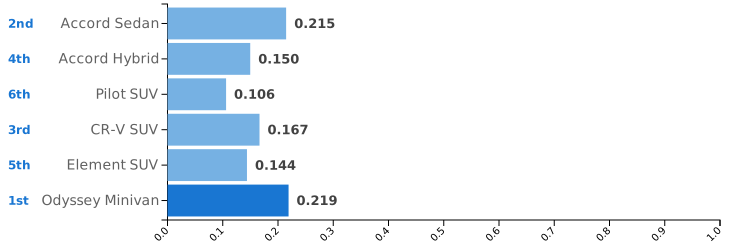
Overall Ranking
| Rank | Alternative | decisionpoint.io Score | Wikipedia Score | Difference |
|---|---|---|---|---|
| 1st | Odyssey Minivan | 0.219 | 0.220 | −0.001 |
| 2nd | Accord Sedan | 0.215 | 0.213 | +0.002 |
| 3rd | CR-V SUV | 0.167 | 0.166 | +0.001 |
| 4th | Accord Hybrid | 0.150 | 0.152 | −0.002 |
| 5th | Element SUV | 0.144 | 0.142 | +0.002 |
| 6th | Pilot SUV | 0.106 | 0.109 | −0.003 |
The ranking order is identical. The Odyssey Minivan wins, the Accord Sedan is a close second, and the Pilot SUV comes last.
The small differences in scores (all within ±0.003) reflect variations in how AHP implementations compute priority vectors — see the methodology note at the end for details. The close match to the published Wikipedia figures is a useful sanity check on our implementation.
What Drove the Result?
The Odyssey Minivan wins because it performs well across the criteria that matter most.
- Safety (weight 0.237). The Odyssey dominates here with a local priority of 0.424, nearly double the second-place Accord. Its weight and crash test performance give it a large advantage on the family's second-most-important criterion.
- Passenger Capacity (weight 0.181). As one of only two 8-passenger vehicles, the Odyssey ties for first with the Pilot.
- Cargo Capacity (weight 0.036). The Odyssey's 148 cubic feet of cargo space is the largest by far.
The Odyssey's weakness is cost. It's over the family's budget, which puts it 4th on Purchase Price. But its dominance on safety and capacity more than makes up for that.
The Accord Sedan's close second-place finish comes from a different profile: strong on cost (2nd on purchase price, 1st on maintenance), competitive on safety (2nd), and leading on style. It's the balanced option.
Criteria Weight Breakdown
The eight leaf criteria, ranked by their global weight, show what's actually driving the decision:
| Criterion | Global Weight | Most favoured alternative |
|---|---|---|
| Purchase Price | 0.246 | Element SUV |
| Safety | 0.237 | Odyssey Minivan |
| Passenger Capacity | 0.181 | Pilot SUV / Odyssey (tied) |
| Fuel Costs | 0.127 | Accord Hybrid |
| Resale Value | 0.081 | CR-V SUV |
| Maintenance Costs | 0.050 | Accord Sedan |
| Style | 0.042 | Accord Sedan / Hybrid (tied) |
| Cargo Capacity | 0.036 | Odyssey Minivan |
No single car wins on every criterion. The Element leads on Purchase Price but comes last on Safety. The Accord Hybrid leads on Fuel Costs but comes last on Purchase Price (it's way over budget). The AHP's job is to pull these trade-offs together into a single ranking that reflects the decision-maker's priorities.
Sensitivity Analysis
The sensitivity analysis shows just how close this decision really is.
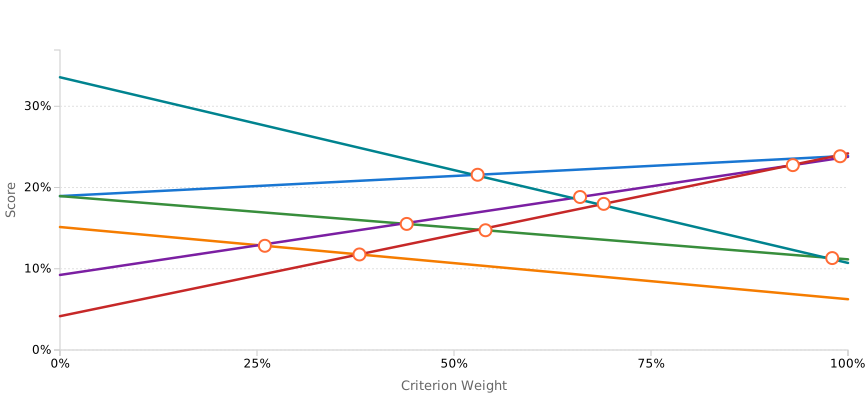
The hollow circles on the chart are crossover points, where two alternatives swap rank as the Cost weight changes. There are seven of them, spread across the chart from about 27% all the way to 70% but most densely packed near the current Cost weight of 51%. That bunching is the visual signature of a fragile ranking: in this region a small shift in the Cost weight cascades into multiple rank changes, not just at the top.
Stability Overview
| Rating | Count |
|---|---|
| Stable | 0 |
| Moderate | 2 |
| Sensitive | 8 |
Eight of the ten criteria are Sensitive: small shifts in their weight could flip the ranking. None are Stable. That's a direct consequence of the tiny margin between the Odyssey (0.219) and the Accord (0.215), a gap of just 0.004.
Stability by Criterion
| Criterion | Weight | Critical Δ | Stability |
|---|---|---|---|
| Cost | 51% | ±2% | Sensitive |
| Purchase Price | 49% | ±3% | Sensitive |
| Fuel Costs | 25% | ±4% | Sensitive |
| Maintenance Costs | 10% | ±2% | Sensitive |
| Resale Value | 16% | ±7% | Sensitive |
| Safety | 23% | ±1% | Sensitive |
| Style | 4% | ±1% | Sensitive |
| Capacity | 22% | ±2% | Sensitive |
| Cargo Capacity | 17% | ±16% | Moderate |
| Passenger Capacity | 83% | ±15% | Moderate |
What This Tells Us
Safety is the most volatile criterion. Critical Δ is ±1%. Even a small shift in how much the family values safety would change the winner: a little more safety focus and the Odyssey pulls further ahead, a little less and the Accord takes over.
Cost is almost as hair-trigger. At ±2%, a small increase in the weight on cost flips the ranking to the Accord. That tracks with intuition, since the Accord is noticeably cheaper than the Odyssey.
The Capacity subcriteria are more resilient. Cargo Capacity (±16%) and Passenger Capacity (±15%) are rated Moderate. The ranking isn't very sensitive to how the family weighs cargo space against passenger space, because the Odyssey leads on both; reallocating weight between them doesn't alter the outcome.
The Practical Implication
This is useful information for the Jones family. It tells them that the choice between the Odyssey and the Accord is essentially a coin flip: the two cars are so close that the "right" answer depends on how they weigh cost against safety at the margin. If someone in the family is a bit more cost-conscious than the consensus suggests, the Accord wins. A bit more safety-focused, and it's the Odyssey.
That's worth more than a false sense of certainty. Rather than "the model says buy the Odyssey," the sensitivity analysis gives the family the clarity to see it as a close call and make a final judgment between two good options.
Try It Yourself
This decision is published as a public, interactive model on decisionpoint.io. You can:
- Explore the full decision: view the hierarchy, all the comparisons, and the detailed results.
- Run your own sensitivity analysis: adjust the criterion weights and see the ranking change in real time.
- Create your own AHP decision: use the same tool to make your own multi-criteria decisions.
Methodology Notes
How decisionpoint.io Calculates AHP Priorities
decisionpoint.io uses the eigenvector method to derive priorities from pairwise comparison matrices, in line with Saaty's original AHP methodology[3]. Small differences from other AHP implementations (typically within ±0.003) come from variations in eigenvector computation. Some tools use the exact principal eigenvector; others use geometric mean approximations; numerical precision varies with the iterative methods used. These differences are negligible and don't change the ranking order. Although the final weights differ slightly from those in the original article, they do match the results of the AHPy library[5].
References
-
Wikipedia contributors. "Analytic hierarchy process – car example." Wikipedia, The Free Encyclopedia. https://en.wikipedia.org/wiki/Analytic_hierarchy_process_%E2%80%93_car_example
-
Saaty, T.L. (2008). Decision Making for Leaders: The Analytic Hierarchy Process for Decisions in a Complex World. RWS Publications.
-
Saaty, T.L. (1990). "How to make a decision: The Analytic Hierarchy Process." European Journal of Operational Research, 48(1), 9–26.
-
Glur, C. (2018). ahp: Analytic Hierarchy Process (R package, version 0.2.12). https://github.com/gluc/ahp
-
Griffith, P. (2021). AHPy: A Python implementation of the Analytic Hierarchy Process. https://github.com/PhilipGriffith/AHPy