New Feature: Fractional Judgment Values
February 12, 2026 · Philip Healy
In pairwise comparisons, allow judgment values that are not whole numbers.

Although whole-number judgments on the standard 1–9 scale are the most commonly used values in AHP pairwise comparisons, fractional values have been part of the process since the very beginning. In his foundational paper "A Scaling Method for Priorities in Hierarchical Structures", Thomas Saaty uses fractional values such as 1.3 and 1.5 in pairwise comparison matrices when estimating the relative distances of cities from Philadelphia.
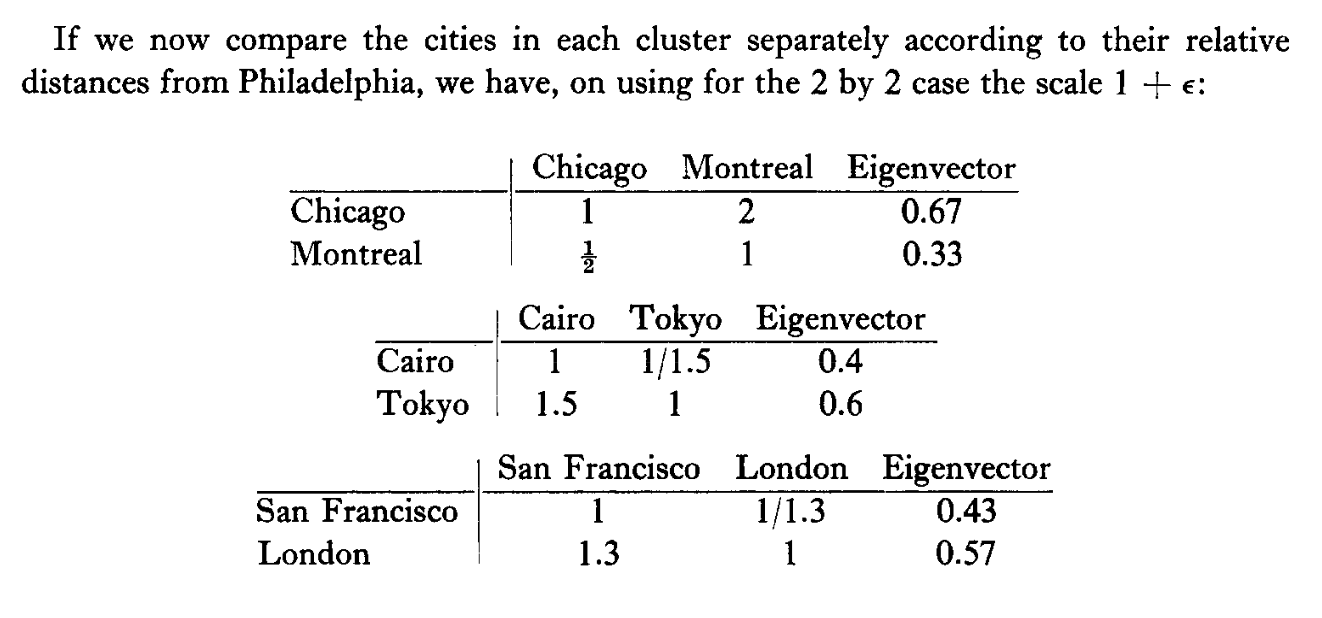
In practice, decision-makers often find that their true preference lies somewhere between two adjacent scale points, and the theory has always accommodated this.
Why We Built This
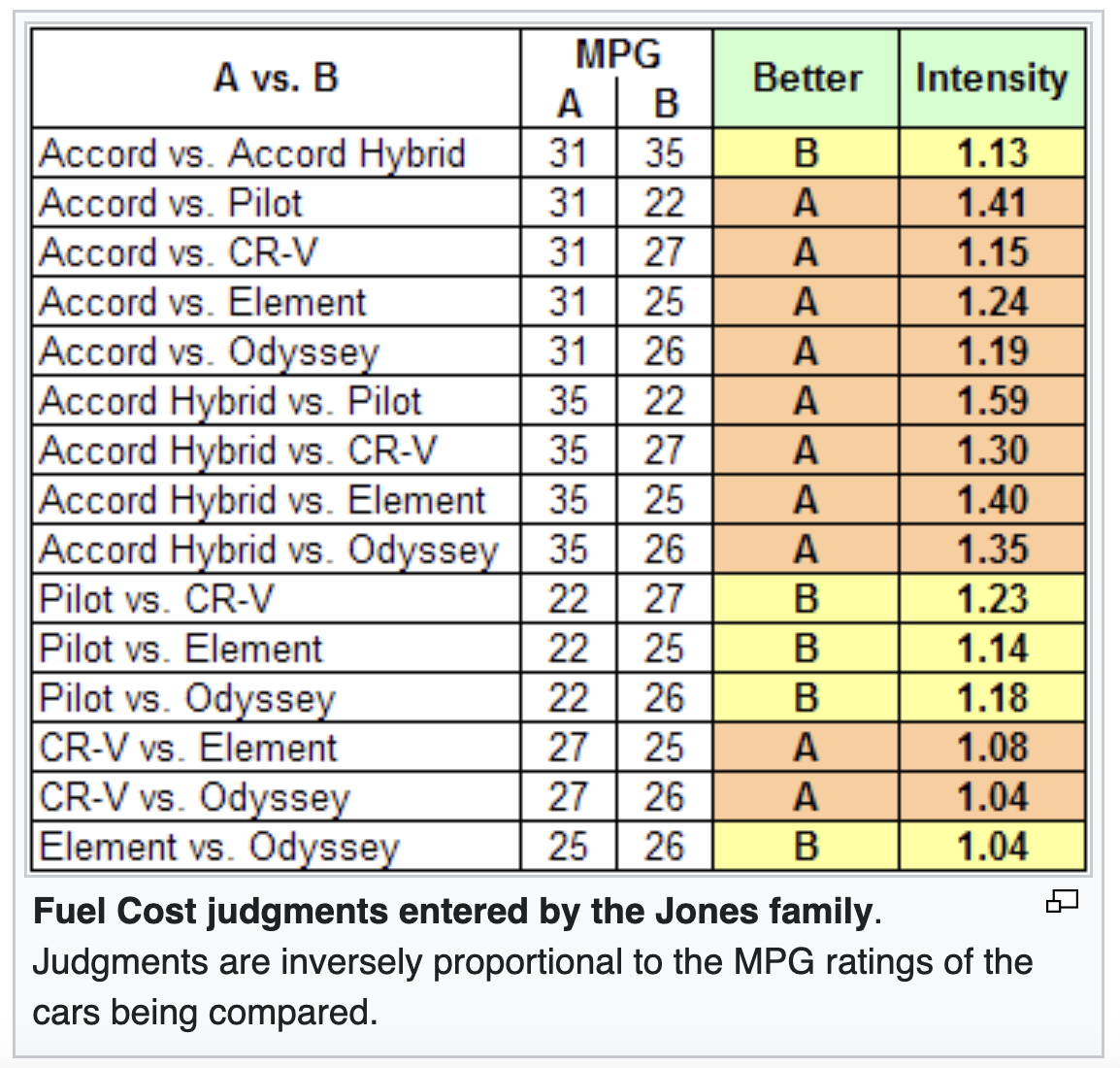
Since we launched decisionpoint.io, we have been actively soliciting feedback from AHP practitioners about what features they would like to see. Support for fractional values was flagged almost immediately. It also came up while trying to replicate the well-known "Choosing a car" example on Wikipedia, where comparing the fuel costs of the different cars requires fractional judgment values that don't fall neatly on integer scale points.
How It Works
When entering a pairwise comparison, you'll now see an Enter fractional value button below the standard judgment slider. Clicking it reveals an input where you can type any decimal value between 1 and 9 — for example, 2.5 to express a preference that sits between "slightly more" and "moderately more".
The input includes a pair of direction toggle buttons that let you quickly switch which side of the comparison the value favours. This makes it easy to experiment: type a value, toggle the direction, and see the description update in real time until you've captured your judgment precisely.
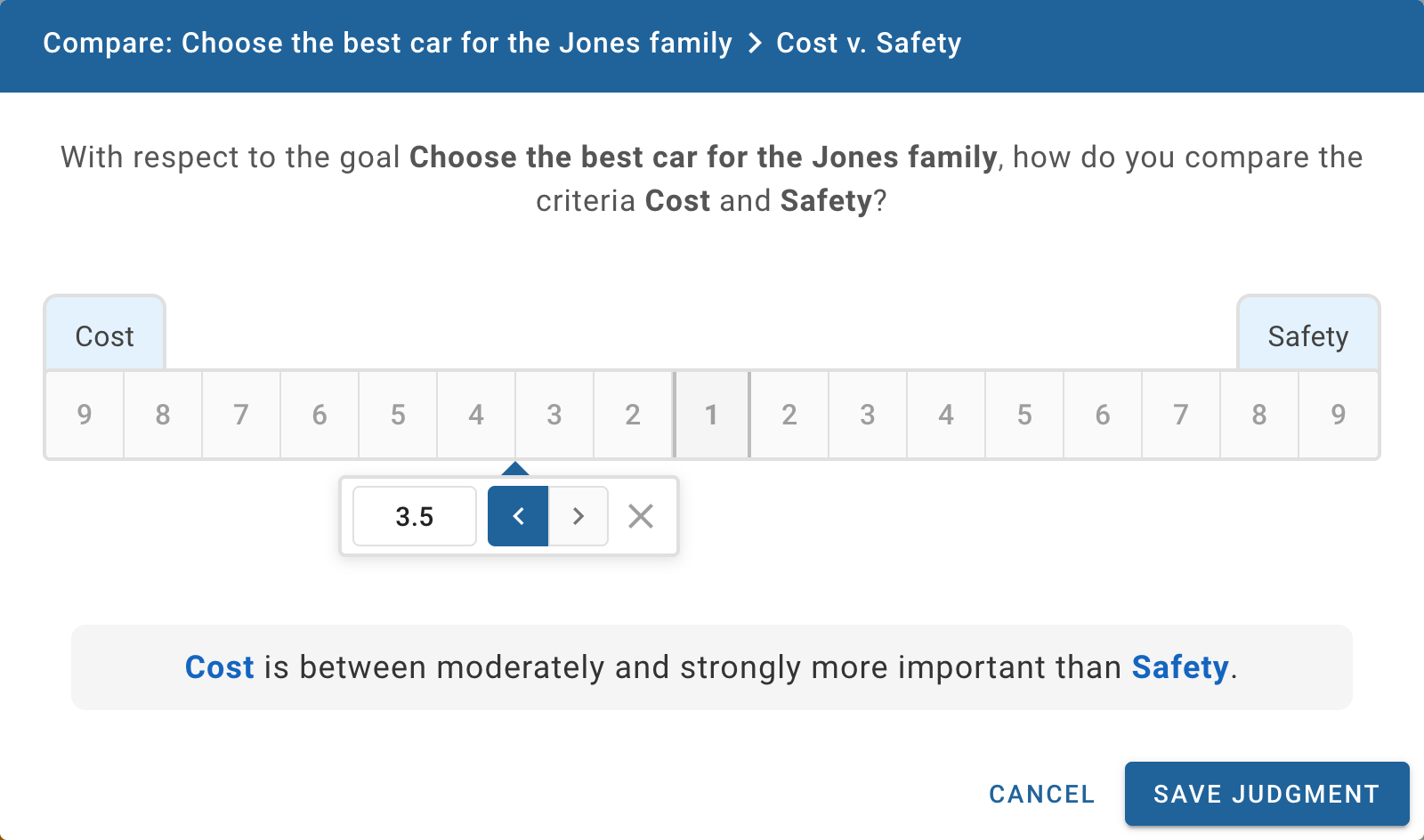
Fractional values are fully integrated throughout the app. Scorecards display the exact fractional value rather than rounding to the nearest integer, and the judgment description text interpolates between the standard semantic labels to give a natural-language reading of your comparison.
Try It Out
The feature is available now for all users — no subscription required. Head over to the app and give it a try. As always, I'm very happy to receive feedback, just use the contact form or send me an email at philip.healy@decisionpoint.io.
— Philip
References
- Saaty, T.L. (1977). "A Scaling Method for Priorities in Hierarchical Structures." Journal of Mathematical Psychology, 15(3), 234–281.
- Wikipedia. "Analytic hierarchy process — car example."